
Vietnam’s 87% Financial Inclusion Milestone Signals New Pathway for Climate-Smart Agriculture as Digital Finance Expands
• Vietnam has reached 87% adult financial inclusion, marking one of the fastest digital finance transformations in ASEAN and positioning the country among the region’s most dynamic digital economies (VietnamPlus, 2025).
• Non-cash transactions are now valued at 26 times national GDP, reflecting the scale and maturity of Vietnam’s digital payments ecosystem and strong public trust in digital financial services (VietnamPlus, 2025).
• Yet despite this progress, smallholder farmers—who support nearly one-third of the national workforce—continue to face challenges accessing data-backed credit and climate-smart financial services, highlighting a growing gap between national-level digital momentum and on-the-ground agricultural realities (World Bank, 2019; ADB, 2022).
Zurich and Hanoi, 28th January 2026 - Vietnam’s agricultural sector remains integral to national development. While its contribution to gross domestic product has declined to around 15.5 percent, the sector continues to support the livelihoods of nearly one-third of the population, underpins national food security and export competitiveness. Vietnam remains among the world’s largest exporters of rice, coffee, pepper, and aquaculture products, making agriculture a strategic pillar of both economic resilience and global trade (ADB, 2022).
For years, however, access to finance has been a persistent constraint on the sector’s modernization. The World Bank’s Vietnam Agriculture Finance Diagnostic Report published in 2019 found that only 24.6% of rural adults held a bank account, just 2.3% used mobile banking, and fewer than one in ten accessed formal credit for farming or business investment. Low financial literacy, fragmented data systems and fragmented market information further reduced confidence among lenders and buyers, slowing productivity gains and sustainability investments (World Bank, 2019).
That landscape has shifted rapidly. Over the past five years, Vietnam has emerged as one of ASEAN’s fastest-growing digital economies. Adult financial account ownership has reached 87%, non-cash payments exceed 26 times national GDP, and QR-based payments recorded more than 80 percent growth in early 2025 alone (VietnamPlus, 2025). These milestones reflect strong government leadership, expanding digital infrastructure, and rising consumer trust in digital financial services.
As Vietnam builds on this momentum, broader structural reforms are advancing in parallel. The planned establishment of International Financial Centers in Ho Chi Minh City and Da Nang is expected to deepen financial integration, attract foreign investment, and support SME-driven, export-oriented growth. Together, these initiatives signal Vietnam’s ambition to position itself as a regional hub for finance, innovation, and digital transformation within global value chains.
Translating Digital Finance into Climate-Smart Agriculture
With national systems rapidly modernizing, attention is increasingly turning to the next challenge: translating digital finance progress into tangible benefits for smallholder farmers. Despite macro-level progress, many producers remain excluded from data-backed credit and climate-smart financial services, limiting their ability to invest in productivity, comply with sustainability requirements, and adapt to climate risks.
Vietnam’s trajectory mirrors developments in regional peers such as Indonesia, where rapid adoption of e-wallets and mobile money transformed rural commerce and SME financing, with e-wallet usage reaching more than half of the population by 2023 (Market Research Indonesia, 2025). Vietnam is advancing along a similar pathway, combining policy commitment with dynamic fintech partnerships. As financial ecosystems expand, digital payments and data-driven lending are increasingly viewed as enablers of climate-smart agriculture—linking incentives to verified sustainable practices while improving transparency across value chains. This approach is gaining urgency as export markets, financial institutions, and regulators place greater emphasis on traceability, environmental accountability, and responsible financing.
Data-Driven Finance in Practice: Bridging Inclusion and Accountability
Field-level implementations illustrate how digital finance can support both inclusion and sustainability when grounded in verified data. Responsible digital wallets designed for rural supply chains are increasingly being used to extend access to formal financial services while embedding safeguards for farmers and lenders alike.
One example is Koltiva’s Responsible e-Wallet, KoltiPay, which supports transparent payments for smallholders and links transaction histories with verified farm data through Koltiva’s integrated traceability ecosystem. This model enables fairer credit assessments, reduces risks associated with cash-based transactions, and encourages responsible borrowing.
First introduced in Vietnam through the GRAFT Challenge in 2021, the model has since expanded across multiple markets. In Indonesia, similar deployments have supported thousands of producers, cooperatives, and financial institutions in transitioning from cash to digital payments, improving financial literacy while unlocking sustainability-linked financing.
When combined with digital traceability systems, data-driven finance can extend beyond inclusion to environmental accountability. In integrated landscapes, digital wallets connected to farm mapping, polygon data, and deforestation monitoring enable financiers to verify that financed volumes are traceable and deforestation-free. This alignment between finance, traceability, and environmental risk management is increasingly relevant as green SME finance, ESG frameworks, and climate regulations demand higher standards of transparency and verification.
As Vietnam’s fintech ecosystem matures, expanding data-driven models that link finance with verified agricultural data offers a pathway to ensure digital finance supports not only economic inclusion but also climate action and sustainable value chains.
Collaboration Signals Growing Momentum
This convergence of digital finance, sustainability, and agriculture has gained momentum through growing collaboration among public and private stakeholders. Discussions at the Swiss–Viet Economic Forum last year highlighted the importance of translating national digital progress into practical, scalable solutions for smallholder farmers and rural
enterprises.
Building on these discussions, Koltiva and the Swiss–Viet Economic Forum have formalized cooperation through a Memorandum of Understanding to advance sustainable agriculture, supply chain transparency, and digital transformation in Vietnam. The collaboration focuses on knowledge exchange, joint forums, and innovation facilitation, reflecting shared recognition that data-driven approaches are essential to inclusive and responsible growth.
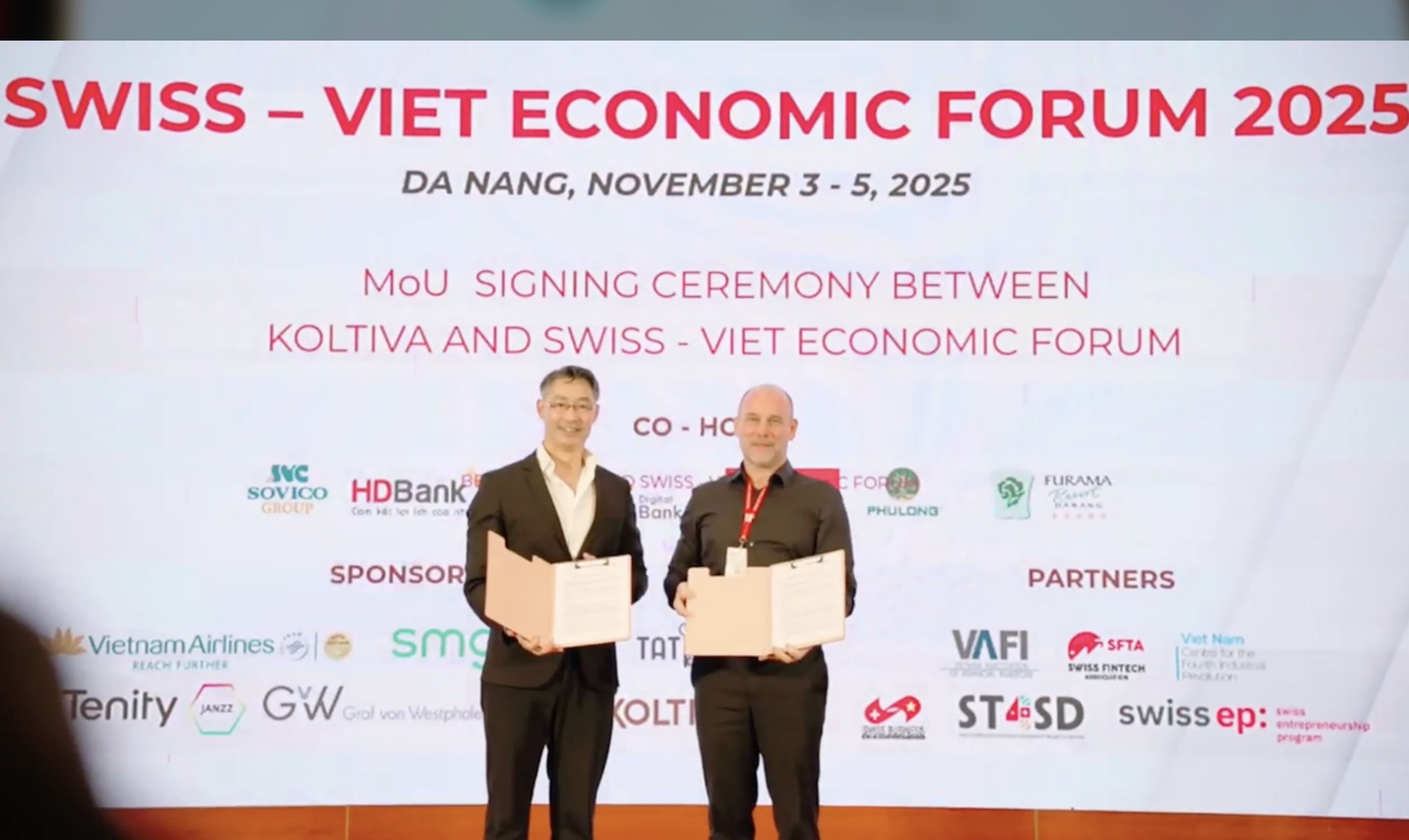
“Vietnam’s digital finance growth creates a unique opportunity to strengthen smallholder resilience while advancing climate-smart agriculture,” said Manfred Borer, Chief Executive Officer and Co-Founder of Koltiva. “By linking verified data with inclusive financial services, it becomes possible to improve transparency, support responsible lending, and enable farmers to invest confidently in sustainable production.”

Looking ahead, aligning digital finance with verified agricultural data will become increasingly important as sustainability expectations rise across global markets. Integrating payments, traceability, and responsible lending offers a pathway to convert Vietnam’s digital momentum into more resilient livelihoods, greener value chains, and measurable climate action.
===
About KOLTIVA
Offering human-centered technology and boots-on-the-ground solutions that digitize agribusinesses and help smallholder producers transition to sustainable practices and traceable sourcing, KOLTIVA is recognized as the leading global sustainable agriculture and supply chain traceability company. As a global technology provider, it constructs ethical, transparent, and sustainable supply chains, assisting enterprises in fortifying their resilience and transparency. The company helps businesses and their suppliers comply with ever- changing regulations and consumer demands worldwide with traceability solutions. Operating in more than 94 countries and fortified by a network of customer support offices in 21 countries, KOLTIVA is committed to supporting over 19,000 enterprises in establishing transparent and robust supply chains while empowering over 2,000,000 producers to increase their annual income. www.koltiva.com
Press contacts KOLTIVA
Daniel Prasetyo
Head of Public Relations & Corporate Communication
+62 8111 671 919
daniel.prasetyo@koltiva.com